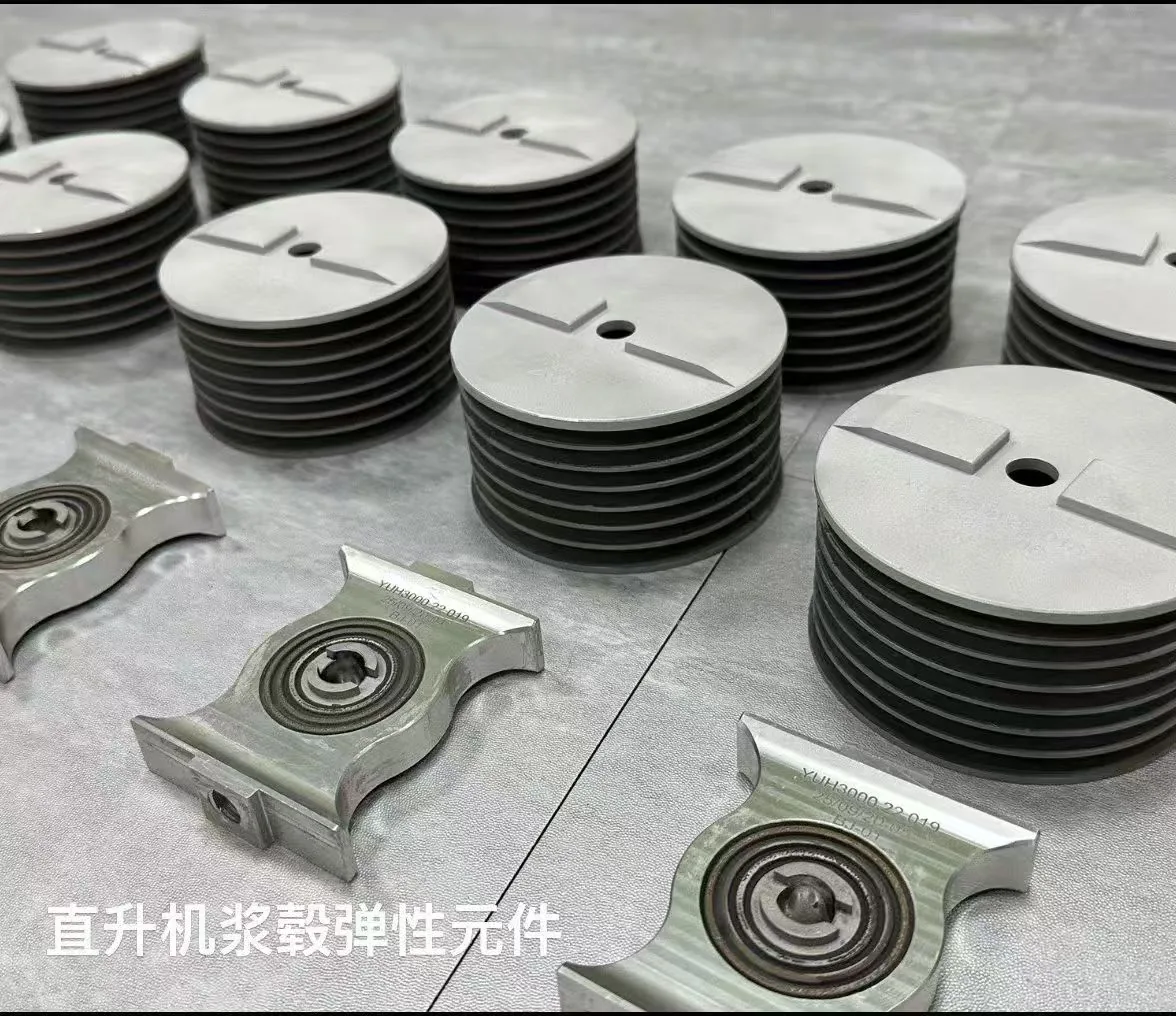
Application background: 3-ton-class tandem-rotor unmanned cargo helicopter
The components shown are for a 3-ton-class large unmanned cargo helicopter using a tandem-rotor arrangement. This configuration places the elastomeric elements within a demanding rotor-system environment, where project-specific stiffness, damping, motion accommodation, bonding integrity and repeatability must be considered together.
“3-ton-class” describes the confirmed project class only. It is not presented here as payload, maximum take-off weight or another unconfirmed aircraft parameter.
Why elastomeric elements are used in a rotor hub
A helicopter rotor hub operates under combined centrifugal loading, aerodynamic excitation, pitch change and repeated cyclic motion. Depending on the rotor architecture, elastomeric bearings may accommodate angular or shear deformation without conventional rolling contact, while elastomeric damping elements contribute energy dissipation and motion control. In a tandem-rotor aircraft, the exact component requirements remain tied to the complete rotor and flight-control architecture.
NASA rotorcraft studies provide examples of elastomeric bearings supporting blade-pitch motion and elastomeric lead-lag dampers restraining in-plane blade motion. These references explain the general technology; they do not define the design or performance of the PRESIS components shown here.
Two silicone material roles in one rotor-hub project
The confirmed material system uses damping silicone and phenyl silicone. They are not interchangeable labels. Damping silicone is selected around energy dissipation and dynamic response, while phenyl silicone is selected where the elastic element must retain useful flexibility in low-temperature service. The approved formulation, hardness, geometry and bonding process still need to be matched to the exact component.
| Material | Primary project role | Characteristics that matter | What must be verified |
|---|---|---|---|
| Damping silicone | Rotor-hub damping element and vibration-energy dissipation | Viscoelastic loss, dynamic stiffness and repeatable hysteretic response under cyclic deformation | Loss factor or equivalent damping measure, stiffness, frequency response, temperature response, strain dependence, heat build-up and fatigue behavior |
| Phenyl silicone | Low-temperature elastomeric bearing or compliant element | Low-temperature flexibility, elastic recovery and controlled deformation across the specified environment | Low-temperature stiffness, hardness, compression or shear behavior, bonded-interface durability, temperature cycling and long-duration load response |
Why damping silicone is used
Damping silicone is a viscoelastic material: part of the deformation energy is stored elastically and part is dissipated. In a rotor-hub damping element, this energy-loss behavior can help restrain defined dynamic motion and reduce the response transmitted through the relevant load path. The useful value is not a single generic “damping coefficient.” Silicone-rubber dynamic properties vary with temperature and frequency, and the finished component also responds to strain level and geometry.
For this reason, material screening should be followed by component-level dynamic testing under project-relevant conditions. Storage modulus, loss modulus, loss factor, dynamic stiffness and temperature rise may all be relevant, depending on the customer's acceptance method.
Why phenyl silicone is used
Phenyl-containing silicone compounds are a recognized direction for low-temperature elastomer applications. In this project, phenyl silicone supports the elastic element's need for flexibility and controlled deformation in the specified low-temperature environment. It remains necessary to confirm the exact compound because phenyl content, filler, cure system and part construction influence mechanical behavior.
Low-temperature capability should therefore be verified on the approved compound and, where required, on the bonded component after temperature conditioning or cycling. General supplier literature for phenyl silicone cannot substitute for the project's own stiffness, deformation, recovery and durability evidence.
The component is an engineered system, not just a rubber part
The damping silicone, phenyl silicone, reinforcing or separating metal layers, bonded interfaces and finished geometry work together. A compound with suitable base properties can still produce the wrong result if layer thickness, bond preparation, cure, concentricity or dimensional control is inconsistent.
- Stiffness direction: axial, radial, torsional and shear behavior may need different levels of compliance.
- Damping behavior: energy dissipation must be considered across the expected motion, frequency and temperature range.
- Load spectrum: steady centrifugal load and cyclic operating loads affect the design and validation plan.
- Environment: temperature, fluids, moisture, ozone and storage conditions can influence the elastomer and bonded interfaces.
- Interfaces: metal geometry, surface preparation and bonding quality are part of the functional component.
Manufacturing controls that matter
Production planning should connect the separate damping-silicone and phenyl-silicone material controls with metal-part inspection, surface treatment, bonding, molding or vulcanization, dimensional inspection and batch traceability. Each compound needs an approved identity and batch route; for layered or bonded structures, uniformity and interface integrity are as important as the visible outer dimensions.
A meaningful control plan is project-specific. It may include approved raw-material batches, controlled process parameters, dimensional checks, bond-quality evaluation and mechanical verification agreed with the customer. PRESIS does not present a generic test value as proof for every rotor-hub configuration.
Information needed before engineering review
To evaluate a large unmanned helicopter rotor-hub elastomeric bearing or damper, the supplier needs more than a part drawing. The following inputs help define the material, structure, tooling and verification route:
- Rotor architecture and the component's position in the load path
- Load directions, load spectrum, motion range and target stiffness
- Damping target plus the relevant excitation frequency, amplitude and operating conditions
- Operating, storage and qualification temperature ranges
- Approved damping-silicone and phenyl-silicone specifications or target property windows
- Expected environment, fluid exposure and service interval
- Metal material, interface requirements and allowable surface treatments
- Critical dimensions, tolerances, inspection method and traceability requirements
- Prototype quantity, test plan, annual demand and change-control rules
How to evaluate a development and production partner
Supplier evaluation should cover elastomer formulation direction, precision metal-to-rubber bonding, tooling, process discipline and repeatable inspection. The discussion should also establish who owns the system-level design, how samples will be qualified, which data define acceptance and how production changes will be controlled.
For an aircraft-critical application, final suitability must be demonstrated through the customer's approved design analysis, component testing and aircraft-level verification. Product images and general capability statements cannot replace qualification evidence for the exact configuration.
Technical references
For general rotor-system context, see NASA's Rigid/Compliant Helicopter Rotor, which discusses elastomeric bearings in blade-pitch control, and Load and Stability Measurements on a Soft-Inplane Rotor System Incorporating Elastomeric Lead-Lag Dampers, which reports experimental work on in-plane rotor damping.
For material behavior, published dynamic-mechanical research on silicone rubber demonstrates that viscoelastic response depends on temperature and frequency. NASA's stiffness and damping procedures for elastomers also treats frequency, geometry and temperature as key variables. Momentive's silicone elastomer portfolio identifies phenyl silicone as a low-temperature specialty-compound direction. These sources support the general material explanation only; project acceptance remains based on the approved PRESIS compound and customer validation plan.
Developing a tandem-rotor unmanned-helicopter elastomer component?
Send the assembly position, drawing, load and motion inputs, environmental conditions and validation requirements. PRESIS can review the material, bonding, tooling and sample-production route with your engineering team.
Discuss the component