
Natural rubber (NR), approximately 75 Shore A.
Robot tire engineering case
Robot Honeycomb Solid Tire: NR 75A, Wear and Approximately 10⁶ Ω Antistatic Target
A robot honeycomb solid tire must balance rolling stability, cushioning, wear behavior, visible marking control and electrical requirements. This PRESIS case records the material and verification direction without turning project targets into universal guarantees.

Application requirements
A robot tire is a system component, not only a molded rubber ring
For mobile robots, the tire connects drive torque, equipment load and the floor. Its condition affects starting, braking, steering feedback, vibration, noise and maintenance. A robot honeycomb solid tire therefore cannot be evaluated only by outside diameter, width or appearance. The engineering review also needs the single-wheel load, speed, turning frequency, continuous running time, floor material, installation interface and the customer's acceptance method.
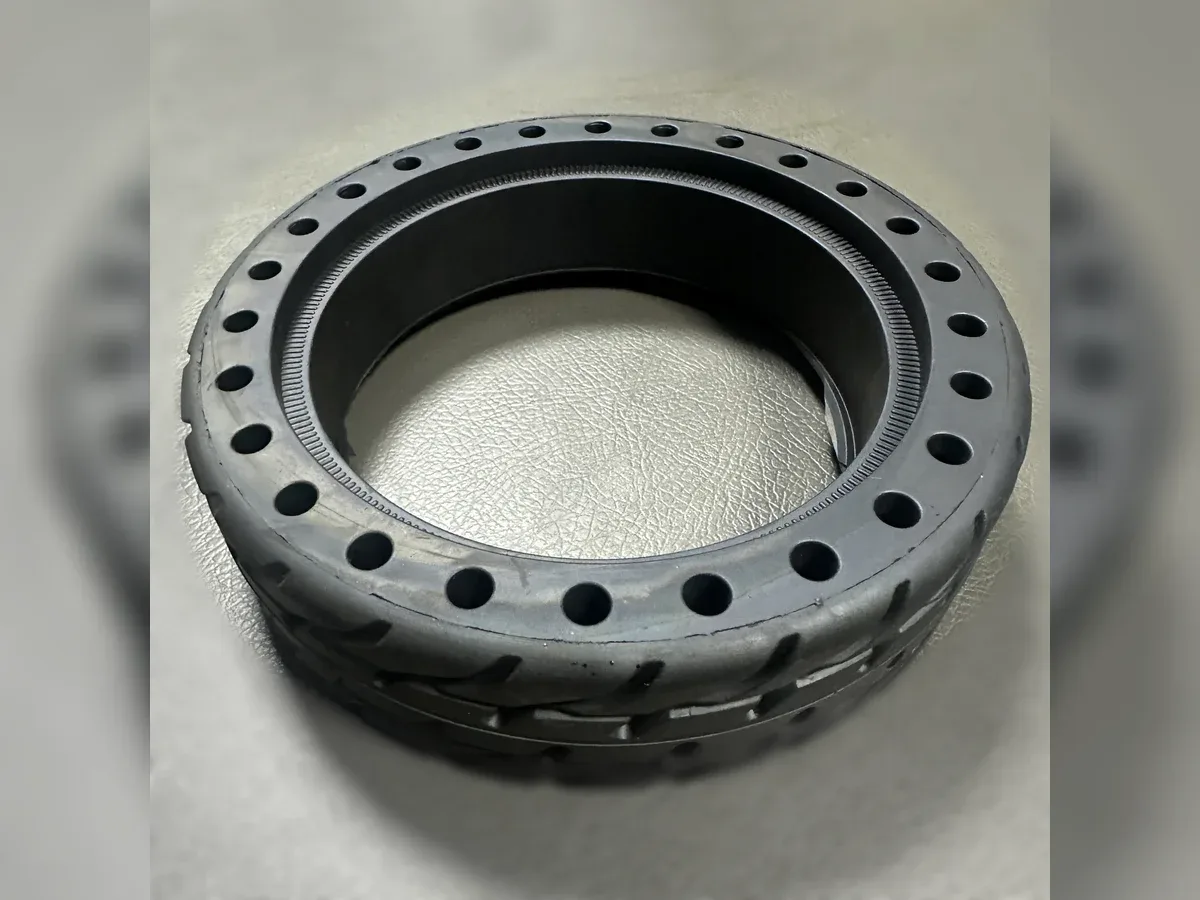
The shown sample uses a puncture-free body with circumferential holes. This direction removes inflation and air-pressure maintenance while retaining controlled deformation space. It is intended to combine solid-tire reliability with a degree of cushioning, but the final load and running result must still be confirmed on the customer's robot.
Honeycomb structure
Honeycomb holes coordinate cushioning, support and heat-related deformation
The circular holes around the tire create repeatable deformation zones. Their diameter, spacing, distance from the tread and relationship with the inner mounting surface must be reviewed together. Too little deformation may transmit impact directly to the robot; too much deformation may affect steering response, rolling resistance or local stress. Mold filling, venting, demolding and dimensional stability also need to be considered before the hole pattern is fixed.
This photograph shows the inner ring, circumferential hole distribution and molded interfaces of the actual sample. It is visual evidence of this sample structure only. It does not define a standard size or a universal load rating for other robots.
Material and hardness
NR at approximately 75 Shore A is matched with the finished tire structure
Natural rubber direction
NR is selected for the documented project direction because elasticity, fatigue behavior, grip and wear must be balanced. The finished-tire result depends on the compound, mixing, curing and structure rather than on the material name alone.
Approximately 75 Shore A
The hardness direction is approximately 75 Shore A. Hardness is checked with the agreed specimen, location, conditioning time and method; a nominal value does not by itself prove rolling life, load capacity or marking performance.
Process consistency
Compound version, mixing batch, molding temperature, pressure, curing time and post-treatment must remain linked to the approved sample so that hardness, appearance and functional checks can be traced during production.
Performance verification
Wear, visible marking, antistatic and environmental requirements use agreed evidence
| Requirement direction | Project expression | Verification boundary |
|---|---|---|
| Wear and visible marking | Under the agreed method, rubbing with white A4 printing paper showed no obvious black mark. | The paper, load, stroke, speed, contact area and acceptance rule must be recorded. This is not an unconditional guarantee for every floor or duty cycle. |
| Antistatic behavior | The project target resistance level is approximately 10⁶ Ω. | The measured quantity, electrodes, voltage, temperature, humidity, conditioning, grounding and finished-wheel method must be confirmed in the technical agreement or report. |
| RoHS and REACH direction | Materials and restricted substances are reviewed against the customer's applicable RoHS and REACH requirements. | Final statements depend on the specified scope, material documents and, when required, a report applicable to the submitted sample or production batch. |
Engineering route
From operating conditions to sample confirmation and controlled production
PRESIS first converts robot conditions into review items: tire envelope, mounting interface, load, speed, turning, floor, target hardness, visible marking method, resistance target and environmental-document requirements. DFM then checks the honeycomb geometry, mold parting, filling, venting, dimensional control and inspection positions. The NR compound and molding window are adjusted against the agreed sample rather than selected from a generic material table.
Trial tires are checked for dimensions, appearance, hardness and hole integrity, followed by the agreed paper-rub, resistance and robot-running checks. Findings return to the structure, compound or process until the sample route is confirmed. Mass production then follows the approved compound version, process window and inspection plan, with changes reviewed before use.
Before sample sign-off, PRESIS also compares the tire condition before and after conditioning and running, records the agreed measuring locations, and separates material, molding and robot-system influences. If the resistance or visible-marking result changes with humidity, floor or grounding, those conditions are retained with the result instead of being removed from the conclusion.
This page describes the supplied sample and the stated project targets. It does not claim a third-party certification, a universal 10⁶ Ω result, a fixed service life or compliance for every finished application. Final acceptance follows the customer-approved drawing, test method, technical agreement and applicable report.
Project input
Send the robot load, speed, floor, tire drawing and acceptance method
For a focused robot honeycomb solid tire review, provide the tire and mounting dimensions, single-wheel load, speed, turning frequency, continuous operating time, floor material, target hardness, paper-rub method, resistance definition and required RoHS or REACH document scope. PRESIS can then align the NR compound, honeycomb structure, mold, sample plan and production controls with the real project.